live_tv
Livestream Starting Soon
00
Hours
:
00
Minutes
:
00
Seconds
Up next in 10


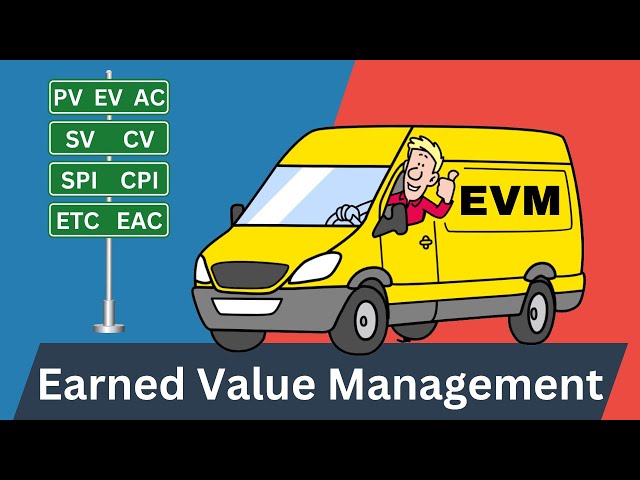
Learning Earned Value Management (EVM) doesn’t have to be intimidating! In this video, Andrew from PMAspirant breaks down complex EVM formulas using a fun and easy-to-follow road trip analogy. You’ll finally understand how Planned Value (PV), Earned Value (EV), and Actual Cost (AC) work together — and how to interpret Schedule Variance (SV), Cost Variance (CV), SPI, CPI, EAC, and ETC with confidence.
Whether you’re preparing for the PMP Exam or want to strengthen your project performance skills, this video will make EVM finally “click.”
By the end of this video, you’ll learn how to:
✅ Calculate PV, EV, and AC with simple examples
✅ Identify if your project is ahead or behind schedule
✅ Evaluate whether you’re over or under budget
✅ Understand Schedule and Cost Performance Indices (SPI, CPI)
✅ Forecast total project cost using four EAC formulas
✅ Apply these concepts to real-world project management scenarios
Chapters:
0:00 – Opening Hook & Setup
0:50 – Planning the Trip (PV, EV, AC)
2:11 – Hitting the Road (SV, CV)
3:13 – Checking Our Pace (SPI & CPI)
4:55 – Forecasting the Finish Line (EAC)
9:06 – Forecasting the Finish Line (ETC, VAC)
10:11 – Closing Message & Call to Action
Show More Show Less View Video Transcript
0:00
If you ever tried learning earned value
0:01
management and felt like you were
0:03
staring at a wall of formulas and none
0:05
of it made sense, you're not alone. EVM
0:08
can feel abstract, especially when it's
0:10
explained only with charts and math. But
0:13
what if I told you we could make EVM fun
0:15
and intuitive? Today, we're not just
0:18
crunching numbers. We're going on a
0:20
cross-country road trip from New York to
0:22
San Francisco. And you are the project
0:24
manager. You've planned the trip
0:26
carefully, mapped the route, estimated
0:28
gas, hotels, and meals. You're excited,
0:31
ready, and fully in control. You
0:33
estimated the total driving distance is
0:35
3,000 mi across the country with
0:37
spending budget of $1 per mile. So, the
0:40
total budget at completion, or BAC, is
0:43
$3,000.
0:44
Now, let's see how this trip becomes the
0:47
perfect analogy to understand earned
0:49
value management. Let's imagine that by
0:52
today, you had planned to drive 600 m.
0:55
That's your planned value, BV. It
0:57
represents the amount of work you plan
0:59
to accomplish by this point. Now, in
1:01
reality, things don't always go as
1:03
planned. You've actually driven 500
1:06
miles so far. That's your earned value,
1:08
EV, the amount of work you've actually
1:10
completed, expressed in budget terms.
1:13
Since each mile was budgeted at $1, your
1:16
EV, is $500.
1:19
And let's check your actual cost AC.
1:22
That's the money you've actually spent
1:24
to drive those 500 miles. Maybe gas,
1:26
snacks, motel, and tolls added up to
1:29
$450 so far. Let's pause here for a
1:32
quick recap. PV, planned value, is equal
1:36
to 600 m planned or $600.
1:40
EV, earned value, is equal to 500 m
1:43
completed or $500. AC, actual cost, is
1:47
equal to $450 spent. So, on paper, you
1:51
plan to be 600 m in, but you've only
1:54
driven 500 and you've spent $450 doing
1:57
it. Let's check how you're performing.
2:00
Now, it's time to compare where you are
2:02
versus where you plan to be. That's
2:05
where variance analysis comes in.
2:07
Specifically, schedule variance, SV, and
2:09
cost variance, CV. Let's start with
2:12
schedule variance, SV, which tells us
2:15
whether we're ahead or behind schedule.
2:17
The formula is SV = EV minus PV. In our
2:22
trip, SV = 500 - 600 = -100.
2:29
That means you're 100 m behind schedule.
2:32
Not terrible, but it's a clear signal
2:34
you've fallen behind your plan. Now,
2:36
what about cost variance, CV? This tells
2:39
us whether you're under or over budget.
2:41
The formula is CV equals EV minus AC. In
2:46
our case, CV equals 500 - 450 equals 50.
2:52
That's a positive number. Great news. It
2:55
means you've spent less than planned for
2:56
the work you've done. You're under
2:58
budget by $50 so far. In short, you're a
3:01
little behind on miles, but you've been
3:03
spending efficiently. Now that we know
3:06
where we stand, let's see how
3:07
efficiently we're moving in spending
3:09
with the performance indices SPI and
3:12
CPI. Let's start with schedule
3:14
performance index SPI. This measures
3:17
schedule efficiency. The formula is
3:19
simple. SPI equals EV / PV. In our trip,
3:26
SPI = 500 / 600 = 0.83.
3:32
That means we're moving at 83% of our
3:34
planned pace. So for every mile we plan
3:37
to drive, we're only completing about 83
3:41
miles. In plain English, we're a bit
3:44
behind schedule. Next up, cost
3:46
performance index. CPI, measures cost
3:50
efficiency, how well we're managing
3:52
money. The formula for CPI is equal to
3:56
EV / AC. So, CPI = 500 / 450 = 1.11.
4:08
That means for every dollar you've
4:09
spent, you're getting $111
4:12
worth of value. Nice. You're traveling
4:15
efficiently, saving money, and
4:17
stretching your budget. Let's summarize
4:20
what these two indices tell us. SPI is
4:23
0.83, which is less than 1, so you are
4:26
behind schedule. CPI is 1.11, which is
4:30
greater than 1, so you are under budget.
4:33
So even though we're running late, we're
4:35
saving money while doing it. This is the
4:38
beauty of EVM. It tells us two stories
4:40
at once. How fast we're going with SPI
4:43
and how wisely we're spending with CPI.
4:46
Now, let's take it one step further. If
4:49
we keep driving at this same pace and
4:51
efficiency, can we predict how the rest
4:53
of the trip will go? Let's find out. By
4:56
now, we've got a sense of our
4:58
performance, which is behind schedule
5:00
but under budget. If things continue
5:02
this way, what will the final cost and
5:04
outcome look like? That's where
5:07
forecasting formulas come in, and
5:08
they're easier than you think when you
5:10
imagine them as roadtrip scenarios.
5:13
Let's start with the main one. Estimate
5:15
at completion, EAC. It predicts the
5:18
total cost of the project when it's
5:19
done. We'll walk through four versions
5:22
of EAC, each matching a different
5:24
driving situation. The first EAC formula
5:27
is EAC equals BAC divided by CPI. Use
5:33
this formula when you expect your
5:35
current cost efficiency to continue for
5:37
the whole trip. In this scenario, you've
5:40
been staying at affordable motel,
5:42
grabbing budget friendly meals, and
5:43
keeping things simple, and you plan to
5:45
keep doing that. In our case, the BAC,
5:49
budget at completion, is $3,000, and the
5:52
CPI is 1.11.
5:55
So, EAC equals 3,000 / 1.11 = $2,73.
6:04
That means if we keep driving and
6:06
spending just as efficiently, we'll
6:07
finish under budget by about $297.
6:12
Nice job. You're on track to save money
6:14
on the trip. Next, let's look at another
6:16
scenario. The second EAC formula is EAC
6:20
equals AC plus BAC minus EV. This
6:24
version assumes early savings were
6:26
temporary and you'll return to your
6:28
original spending pace. In other words,
6:31
you were frugal early on, but now you
6:33
plan to loosen up for the remainder of
6:35
the trip. Maybe enjoy nicer hotels or
6:37
treat yourself to some good meals. So,
6:40
let's plug in the numbers. EAC equals
6:43
450 + 3US 500. This equals $450 + $2,500
6:51
and the result is $2,950.
6:56
That means you'll still finish slightly
6:58
under budget by $50. You're back to a
7:00
balanced approach, but spending a bit
7:02
more. Let's look at another scenario.
7:05
The third EAC formula is EAC equals AC
7:08
plus BAC minus EV / CPI * SPI. This
7:14
one's used when you expect your current
7:16
cost and schedule performance to
7:18
continue. Both matters here. It's like
7:20
saying, "We're still spending
7:22
efficiently, but our slow progress will
7:24
stretch the trip out longer." Maybe
7:26
you've been stuck in traffic, taking
7:28
longer rest stops, or deciding to enjoy
7:30
scenic routes. You're not wasting money,
7:33
just taking more time. Let's calculate.
7:36
EAC equ= 450 + 3 - 500 / 1.11*
7:47
0.83.
7:49
This equals 450 + 2500
7:53
/ 09213.
7:56
This equals to 450 + 2713.66
8:02
66, which equals to $3,16366.
8:08
You'll finish the trip over budget by
8:10
about $164.
8:12
So in this case, even though you're
8:14
being costefficient, the delay adds more
8:16
total cost, maybe extra hotel nights,
8:19
food, or gas. Next, let's look at the
8:22
last scenario. The fourth EAC formula is
8:26
EAC equals AC plus bottomup ETC. This
8:30
one is for when you replan the rest of
8:33
your journey entirely. It's a fresh
8:35
estimate from scratch. Let's say you
8:38
decide to change the route or visit more
8:40
attractions and make it a real
8:41
adventure. You estimate the rest of the
8:44
trip will now cost $2,800.
8:47
So, EAC equals 450 + 2,800, which equals
8:52
$3,250.
8:55
That means you'll end up $250 over
8:58
budget. But hey, you're making lifelong
9:00
memories, right? This version reflects a
9:02
bottom-up approach with new plan and new
9:05
estimate. Now that we've seen all four
9:07
forecasting options, let's quickly
9:09
calculate two more handy values that
9:11
help us interpret the results. ETC or
9:14
estimate to complete is simply the
9:16
remaining cost to finish the trip. The
9:19
formula for ETC is ETC equals EAC minus
9:24
AC. For this calculation, we will use
9:26
the result from our first EAC scenario,
9:29
which equals 2,73.
9:32
So, etc equals $2,73US
9:36
450. The result is $2,253
9:40
left to spend for the rest of the trip.
9:43
And finally, VAC or variance at
9:46
completion is the difference between
9:48
your original budget BAC and your new
9:51
forecast EAC. So, VAC equals B A minus E
9:56
A, which is 300US 2,73.
10:00
The result is $297
10:03
savings. So, if you keep performing at
10:06
this pace, you'll finish the trip with
10:08
$297
10:09
left in your wallet. And there you have
10:12
it. You've just driven across the
10:13
country and learned earn value
10:15
management along the way. Hopefully,
10:17
this journey helped make those
10:19
intimidating formulas come to life in a
10:21
way that's easy to remember. Maybe next
10:24
time you plan a real road trip, you'll
10:26
even find yourself thinking in EVM.
10:28
Here's a question. You learned four
10:30
methods of calculating estimate at
10:32
completion. Which one is your preferred
10:34
method for predicting the total cost of
10:36
the trip and why? Let us know in the
10:39
comments below. If you enjoyed this fun
10:42
learning adventure, give this video a
10:44
like, share it with your classmates, and
10:46
subscribe to PM Asper for more engaging
10:48
project management videos. Thanks for
10:51
watching, and I will see you in the next
10:53
video.
#Business & Industrial
#Travel & Transportation