live_tv
Livestream Starting Soon
00
Hours
:
00
Minutes
:
00
Seconds
Up next in 10

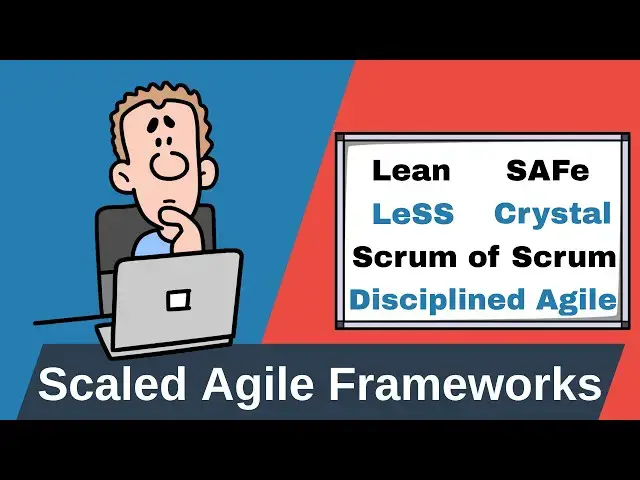
Scaled Agile Framework Explained – Lean, SAFe, Scrum of Scrums, LeSS, DA, Crystal + PMP Questions
Jul 27, 2025

How do you scale Agile across multiple teams and departments without losing alignment and value delivery?
In this video, we’ll break down 6 key Scaled Agile frameworks: Lean, SAFe, Scrum of Scrums, LeSS (Large-Scale Scrum), Disciplined Agile, and Crystal. For each framework, you'll learn what it is, when to use it, and how it appears on the PMP exam—plus you'll test your understanding with realistic PMP-style practice questions along the way.
✅ Learn how to:
• Differentiate between the most popular Scaled Agile frameworks
• Understand the strengths and ideal use cases for each framework
• Apply Lean thinking to optimize flow and reduce waste
• Align teams using SAFe roles, PI Planning, and ARTs
• Coordinate cross-team work using Scrum of Scrums and LeSS
• Customize Agile delivery using Disciplined Agile’s flexible toolkit
• Choose lightweight methods like Crystal for small, high-trust teams
• Tackle PMP scenario questions with confidence
Chapters
0:00 Intro
0:39 Lean
3:58 SAFe (Scaled Agile Framework)
8:11 Scrum of Scrums
11:48 LeSS (Large-Scale Scrum)
Show More Show Less View Video Transcript
0:00
Do you know how agile works when it
0:02
scales across multiple teams and
0:03
departments? In this video, we'll walk
0:06
through the most important scaled agile
0:09
frameworks you need to know. Lean, safe,
0:11
scrum of scrums, less disciplined,
0:13
agile, and crystal. We'll explain how
0:16
each one works, what makes it unique,
0:18
and when to use which framework. At the
0:21
end of each framework, we will go over a
0:24
practice question together to help
0:26
reinforce the learning.
0:28
Be sure to stick around to the end to
0:30
get a clear picture of how these
0:32
frameworks handle coordination,
0:34
alignment, and delivery across large
0:36
organizations.
0:38
Let's get started. One, lean. Lean is
0:42
not a framework itself, but a
0:44
foundational mindset and philosophy that
0:46
influences many skilled agile
0:47
frameworks. Lean focuses on maximizing
0:50
value for the customer while eliminating
0:52
waste. This approach originated from the
0:54
Toyota production system and has become
0:57
central to agile and business agility
0:59
practices. Key concepts in lean include
1:03
the seven types of waste which refer to
1:05
overp production, waiting,
1:07
overprocessing, excess inventory,
1:09
unnecessary motion, transport and
1:12
defects. Value stream mapping which
1:14
helps visualize the flow of value and
1:16
identify inefficiencies in the process.
1:19
Just in time means work is created only
1:22
when needed reducing unnecessary effort
1:25
and inventory. Kazan is the practice of
1:28
continuous incremental improvement over
1:30
time. Built-in quality ensures that
1:32
quality is part of the process, not
1:34
something added at the end. Respect for
1:37
people means empowering teams,
1:39
encouraging collaboration, and fostering
1:41
a culture of ownership. For the PMP
1:44
exam, expect to see lean principles
1:45
appear in scenario-based questions about
1:48
identifying inefficiencies, removing
1:50
waste, and improving team or process
1:52
performance. Let's look at a lean
1:54
question together. A project team
1:57
supporting an internal operations tool
1:59
is struggling to meet delivery
2:01
timelines. Developers often wait for
2:03
clarification on business requirements
2:04
and completed work sits in cues waiting
2:07
for approval. The project manager
2:09
familiar with lean principles wants to
2:11
address these inefficiencies without
2:13
adding more resources.
2:15
What is the best course of action to
2:17
improve the team's performance using
2:19
lean thinking? A. Increase the team's
2:22
velocity by assigning parallel tasks to
2:24
all members and reducing idle time. B.
2:28
Implement a formal change request
2:30
process to document all clarifications
2:33
and decisions. C. Reduce batch sizes and
2:36
focus on limiting handoffs and wait
2:38
times to improve overall flow. B.
2:42
Schedule more meetings between the
2:44
developers and stakeholders to clarify
2:46
requirements early. You can pause the
2:48
video here if you need more time. All
2:50
right, let's walk through this together.
2:52
The correct choice is C. Lean principles
2:55
emphasize flow efficiency, reducing
2:57
waste, and delivering value quickly. In
2:59
this scenario, the delays are due to
3:01
waiting and handoffs, both considered
3:03
forms of waste in lean. By reducing
3:06
batch sizes and limiting handoffs, the
3:08
team can deliver smaller increments
3:10
faster, receive feedback sooner, and
3:12
improve performance without needing more
3:14
resources. Choice A is incorrect.
3:17
Increasing parallel work may seem
3:20
productive, but often leads to context
3:22
switching and more work in progress,
3:24
which decreases overall flow efficiency
3:27
and can create even longer delays.
3:30
Choice B is incorrect. Adding more
3:32
formal processes like a change request
3:34
system introduces bureaucracy and slows
3:37
down response times. Lean advocates
3:39
streamlining processes, not adding
3:41
overhead. Choice D is incorrect. While
3:44
improving communication is valuable,
3:46
simply increasing meeting frequency
3:48
doesn't directly address systemic flow
3:51
inefficiencies. The underlying problem
3:53
is how work moves, not just how it's
3:55
discussed. Okay, let's move on if you
3:58
are ready. Two, safe. SAFE, which stands
4:02
for scaled agile framework. SAFE is one
4:04
of the most widely adopted frameworks
4:06
for applying agile at scale in large
4:08
organizations. SAFE provides structure
4:11
at multiple levels from team to
4:13
portfolio and integrates lean, agile and
4:16
devops principles. Key concepts in safe
4:19
include agile release train which is a
4:22
long-living team of agile teams working
4:24
together toward a common goal. Each
4:27
agile release train typically delivers
4:29
value on a regular cadence. Program
4:32
increment planning which is a
4:33
large-scale planning event conducted
4:35
every 8 to 12 weeks to align multiple
4:37
teams and ensure shared priorities. Lean
4:40
portfolio management which connects
4:42
strategy to execution by aligning
4:44
budgets, road maps and governance. SAFE
4:47
also introduces roles like the release
4:49
train engineer who acts as the chief
4:51
scrum master for the agile release train
4:54
product management which owns the
4:56
program backlog and solution architects
4:58
who guide technical alignment. There are
5:01
four safe configurations to adapt to
5:03
different enterprise needs. Essential
5:06
safe covers the basics needed for teams
5:08
and agile release trains. Large solution
5:11
safe supports complex systems involving
5:13
multiple agile release trains. Portfolio
5:17
safe adds portfolio level strategy and
5:19
governance. Full safe combines all of
5:22
the above for enterprisewide agility.
5:25
SAFE's core values include alignment,
5:27
built-in quality, transparency, and
5:30
program execution. For the PMP exam,
5:33
make sure you're familiar with terms
5:34
like agile release train, program
5:37
increment planning, and lean portfolio
5:39
management, and understand how SAFE
5:41
enables multiple agile teams to deliver
5:44
value at scale. Let's look at a scaled
5:47
agile framework question together. A
5:50
large enterprise is implementing SAFE to
5:52
improve coordination across multiple
5:54
agile teams working on a shared product.
5:56
During a program increment PI planning
5:58
session, several teams express concern
6:00
about overlapping dependencies and
6:02
unclear priorities. As a result, some
6:05
teams are uncertain about their
6:06
objectives and delivery timelines. The
6:09
release train engineer escalates the
6:10
issue to the project manager. What is
6:12
the best action the project manager can
6:14
take to support alignment and successful
6:16
value delivery within the safe
6:18
framework? A. Direct each team to
6:21
finalize their own PI objectives
6:23
independently to maintain team autonomy.
6:26
B. Facilitate a rep prioritization of
6:29
features through the product management
6:30
team and realign the program backlog. C.
6:34
Ask teams to delay commitment until all
6:36
dependencies are resolved through
6:38
documentation. B. Escalate the issue to
6:41
the lean portfolio management team for
6:43
immediate resolution and resource
6:45
allocation. You can pause the video here
6:48
if you need more time. All right, let's
6:50
walk through this together. The correct
6:52
choice is B. In safe program increment
6:56
and PI planning is a critical event for
6:58
aligning teams, identifying
7:00
dependencies, and committing to shared
7:02
PI objectives. When dependencies or
7:04
priorities are unclear, the product
7:06
management team responsible for the
7:08
program backlog should work with teams
7:10
to rep prioritize features and provide
7:13
clarity. This ensures that the agile
7:15
release train can move forward in a
7:16
coordinated and valuedriven manner.
7:19
Choice A is incorrect. While team
7:22
autonomy is important in safe, teams
7:24
operate as part of a larger system, the
7:27
agile release train. Finalizing
7:29
objectives in isolation undermines cross
7:31
teamam alignment and risks delivery
7:34
failure due to unadressed dependencies.
7:37
Choice C is incorrect. Delaying
7:39
commitment until all dependencies are
7:41
documented is contrary to SAFE's inspect
7:44
and adapt philosophy. SAFE encourages
7:47
teams to surface and manage dependencies
7:49
collaboratively during PI planning, not
7:51
defer planning. Choice D is incorrect.
7:55
Escalating to lean portfolio management
7:58
is not appropriate for resolving PI
8:00
planning level concerns. LPM focuses on
8:03
strategic funding and portfolio level
8:04
initiatives, not immediate future level
8:07
prioritization or dependency resolution.
8:09
Okay, let's move on if you are ready.
8:12
Three, scrum of scrums. Scrum of scrums
8:16
is a lightweight coordination method
8:18
used when multiple scrum teams work on
8:20
the same product. The goal is to help
8:22
teams remain aligned, manage cross team
8:24
dependencies, and ensure consistent
8:26
progress toward a shared goal. Here's
8:29
how Scrum of Scrums works. Each Scrum
8:32
team continues to follow standard Scrum
8:34
practices, sprints, daily stand-ups, and
8:37
retrospectives. The representatives from
8:40
each team, often the Scrum Masters,
8:43
attend a Scrum of Scrums meeting to
8:45
share updates, raise issues, and
8:47
coordinate work. A facilitator,
8:50
sometimes called a chief scrum master,
8:52
helps guide the discussions and support
8:54
collaboration across teams. Scrum of
8:56
scrums keeps the simplicity of scrum
8:58
intact while adding a thin layer of
9:00
coordination, making it suitable for
9:01
teams that don't need the full structure
9:03
of safe. On the PMP exam, look for
9:06
scenarios where a small number of scrum
9:08
teams need lightweight synchronization.
9:10
Scrum of scrums may be the best fit when
9:12
you want minimal overhead but need to
9:14
manage shared backlogs or dependencies.
9:17
Let's look at a scrum of scrums question
9:19
together. A company has four scrum teams
9:23
working on different components of a
9:24
single product. Each team runs its own
9:26
sprint, but teams often face delays due
9:29
to unresolved interteam dependencies.
9:31
The product owner has suggested holding
9:33
a large daily meeting with all team
9:35
members to improve visibility. However,
9:37
this has led to long unproductive
9:39
sessions. As the project manager, you
9:42
want to improve synchronization without
9:44
increasing meeting overhead. What is the
9:47
best course of action to enable
9:49
coordination and manage dependencies
9:51
across teams using agile practices? A.
9:55
Introduce a scrum of scrums meeting with
9:56
designated representatives from each
9:58
team to identify and resolve cross team
10:02
issues.
10:03
B. Require all scrum teams to align
10:06
their sprint schedules and attend each
10:08
other's daily standups for transparency.
10:12
C. Replace individual team standups with
10:15
one consolidated standup attended by all
10:18
members of every team. D. Assign a
10:21
central project coordinator to track
10:23
dependencies and provide updates to all
10:25
teams through a weekly report. You can
10:27
pause the video here if you need more
10:29
time. All right, let's walk through this
10:32
together. The correct choice is A. The
10:35
Scrum of Scrums is a lightweight
10:36
coordination technique used when
10:38
multiple scrum teams work on a shared
10:40
product. It involves selecting
10:41
representatives, often scrum masters or
10:44
rotating team members to meet regularly
10:47
and address cross teamam dependencies,
10:49
blockers, and integration concerns
10:51
without disrupting each team's autonomy.
10:53
It allows for synchronization with
10:55
minimal overhead, making it ideal for
10:58
small to midscale agile programs.
11:01
Choice B is incorrect. While aligning
11:03
sprint schedules may help, attending
11:06
each other's daily stand-ups is
11:07
inefficient and increases overhead,
11:10
especially as team members grow, it also
11:13
doesn't scale well or respect each
11:15
team's focus. Choice C is incorrect.
11:18
Consolidating all daily standups defeats
11:20
the purpose of the short focused scrum
11:23
event and leads to information overload,
11:26
which the scenario already shows is
11:28
problematic. Choice D is incorrect.
11:31
Assigning a central coordinator to
11:33
manage communication contradicts the
11:35
agile principle of self-organizing
11:37
teams. It also introduces a single point
11:40
of failure and reduces team ownership of
11:43
dependencies and integration. Okay,
11:45
let's move on if you are ready or less.
11:50
Less which stands for large-scale scrum
11:53
is an extension of scrum designed for
11:55
two to eight teams working together on a
11:57
single product. The idea behind less is
12:00
to scale scrum while keeping it simple
12:02
rather than adding new roles or layers.
12:05
Less extends the core scrum principles
12:07
to larger teams. Key elements in less
12:10
include a single product owner who
12:13
manages one product backlog shared
12:15
across all teams. Teams operate on a
12:18
common sprint cadence starting and
12:20
ending sprints at the same time. A
12:22
shared definition of done applies across
12:24
all teams to ensure consistency and
12:27
alignment. Minimal additional roles are
12:30
introduced. Less emphasizes
12:32
transparency, learning, and empiricism.
12:35
There are two levels. Less for up to
12:37
eight teams. Less huge for scaling
12:40
beyond eight teams using an area-based
12:42
approach. For the PMP exam, expect less
12:46
to show up in questions about scaling
12:48
agile while maintaining scrum
12:50
principles. It's a great fit when your
12:52
organization wants to avoid excessive
12:54
complexity and stick closely to the
12:56
original Scrum structure. Let's look at
12:58
a large-scale Scrum question together.
13:01
An organization is scaling Scrum across
13:03
five teams working on a single product.
13:06
Leadership wants to maintain strong
13:07
alignment with core Scrum values while
13:09
avoiding the complexity of layered
13:11
governance or multiple roles. The teams
13:13
share a single product backlog and
13:15
product owner. But recently,
13:17
inconsistencies have emerged in how
13:19
features are implemented. Some teams
13:21
feel disconnected from customer needs
13:22
and unclear on priorities. As the
13:25
project manager, what is the best way to
13:27
strengthen alignment and maintain the
13:29
simplicity of scrum in this scaled
13:31
environment? A. Introduce team leads to
13:34
coordinate work between teams and
13:37
communicate with the product owner on
13:39
behalf of each team. B. Assign each team
13:42
its own product owner and product
13:44
backlog to reduce confusion and allow
13:46
more autonomy. C. Hold joint sprint
13:49
planning reviews and retrospectives with
13:51
all teams to ensure shared understanding
13:53
and alignment. D. Appoint a central
13:56
integration manager to oversee
13:58
consistency across the product and
14:00
approve all changes before release. You
14:03
can pause the video here if you need
14:04
more time. All right, let's walk through
14:07
this together. The correct choice is C.
14:10
Large-scale scrum is designed to scale
14:13
scrum while preserving its core
14:15
simplicity and principles. Unless teams
14:17
working on the same product share one
14:19
product owner and one product backlog to
14:22
maintain alignment and transparency.
14:24
Joint sprint planning, reviews and
14:26
retrospectives are held. This promotes
14:28
shared understanding, encourages cross
14:30
team collaboration and reinforces a
14:32
product level focus, not just team level
14:35
execution. Choice A is incorrect.
14:38
Introducing team leads adds a non-scrum
14:40
role and undermines the self-managing
14:43
nature of scrum teams. It also risks
14:45
creating a communication bottleneck
14:47
between teams and the product owner.
14:50
Choice B is incorrect. Less deliberately
14:53
uses one product owner and one product
14:55
backlog to maintain product level focus.
14:58
Splitting responsibilities dilutes
15:00
priorities and leads to local
15:01
optimization rather than whole product
15:03
thinking. Choice D is incorrect.
15:06
Appointing a central integration manager
15:08
introduces command and control
15:10
oversight, contradicting less
15:12
principles. Less encourages teams to
15:15
self-organize around integration and
15:17
coordination, not rely on hierarchical
15:20
gatekeepers.
15:21
Okay, let's move on if you are ready.
15:24
Five, discipline agile. Discipline agile
15:28
or DA is not a single framework but a
15:31
decisionmaking toolkit that helps
15:34
organizations and teams choose their
15:36
best way of working. Disciplined agile
15:39
integrates practices from scrum, conbon,
15:41
safe, lean, and more and helps teams
15:44
make better choices based on their
15:45
context. Key concepts in disciplined
15:48
agile include choose your way of working
15:50
which encourages teams to tailor
15:52
practices that fit their situation
15:54
rather than blindly following a specific
15:56
framework. Disciplined agile delivery is
15:59
the foundational layer that focuses on
16:02
value delivery from inception through
16:04
deployment process goals that guide
16:07
decision-m across areas like
16:09
architecture, quality, governance and
16:11
risk. Disciplined agile emphasizes being
16:15
contextsensitive,
16:16
goaloriented, and enterprise aware. For
16:19
the PMP exam, you may encounter
16:21
questions about tailoring agile to fit
16:23
organizational or team specific needs.
16:26
Remember that disciplined agile promotes
16:28
flexibility, pragmatism, and guided
16:31
choices rather than rigid adherence to
16:33
one method. Let's look at a disciplined
16:36
agile question together. A global
16:38
enterprise is launching a high-risk
16:40
compliance-driven project. The team has
16:43
experience with Scrum, but is concerned
16:45
it may not provide enough structure for
16:47
regulatory needs. Leadership wants to
16:50
use an agile approach, but also ensure
16:52
proper risk management and
16:53
documentation. As the project manager,
16:57
you recommend disciplined agile to guide
16:59
the team. What is the best reason to use
17:03
discipline agile in this scenario? A.
17:06
Disciplined agile offers a prescriptive
17:08
process model for delivering software in
17:10
regulated environments. B. Disciplined
17:13
agile allows teams to tailor their way
17:15
of working by choosing practices that
17:17
fit their unique context and
17:19
constraints. C. Disciplined agile
17:22
eliminates the need for documentation by
17:24
replacing it with working software and
17:26
rapid feedback. D. Using discipline
17:30
agile requires switching completely away
17:32
from scrum and adopting a new framework
17:34
based on lean governance. You can pause
17:38
the video here if you need more time.
17:40
All right, let's walk through this
17:42
together. The correct choice is B.
17:45
Disciplined agile is a process decision
17:47
toolkit, not a prescriptive framework.
17:49
It supports teams in tailoring their way
17:51
of working based on organizational
17:53
context, team maturity, compliance
17:55
needs, and more. This pragmatic,
17:58
flexible approach allows teams to choose
18:00
from various agile, lean or traditional
18:02
techniques to achieve desired outcomes,
18:04
making it ideal for complex, high-risk,
18:06
or highly governed environment. Choice A
18:09
is incorrect. Discipline agile is not a
18:12
prescriptive model. While it supports
18:14
working in regulated environments, it
18:16
does so by helping teams make guided
18:19
decisions, not by offering a fixed
18:21
process for compliance. Choice C is
18:24
incorrect. Disciplined agile values
18:27
appropriate documentation when needed.
18:29
Replacing documentation entirely is
18:32
contrary to disciplined agile's
18:33
contextsensitive approach, especially in
18:36
compliance-driven or enterprise scale
18:38
projects. Choice D is incorrect.
18:42
Disciplined agile does not require
18:44
abandoning scrum or any other method.
18:46
Instead, it encourages teams to build
18:48
upon what works, tailoring and evolving
18:51
their way of working using guided
18:52
choices, including elements from Scrum,
18:55
Conbon, XP, SAFE, and others. Okay,
18:59
let's move on if you are ready. Six.
19:02
Crystal. Crystal is a family of agile
19:05
methods that emphasizes people,
19:07
interactions, and context over strict
19:10
processes and heavy tools. It's highly
19:12
adaptable and designed to scale based on
19:15
team size and project criticality using
19:18
color-coded variance to indicate the
19:20
level of formality needed. Crystal Clear
19:23
is ideal for small teams of up to six
19:25
people working on lowrisk projects. It
19:27
focuses on close communication, quick
19:29
delivery, and minimal process. Crystal
19:32
yellow supports teams of 10 to 20 with
19:34
slightly more structure for moderately
19:36
critical work. Crystal Orange is used
19:39
for larger teams of 20 to 40,
19:41
introducing more roles, coordination,
19:43
and governance. For high-risk or
19:45
missionritical projects, Crystal Red and
19:48
Beyond, like blue or violet, offer
19:50
greater rigor, documentation, and
19:52
control. What unites all Crystal
19:55
variants is their shared values,
19:57
frequent delivery of working software,
20:01
reflective improvement, which encourages
20:03
teams to continuously learn and adapt.
20:07
cosmetic communication, meaning team
20:10
members should sit close together to
20:12
share information naturally and
20:14
efficiently. Tailoring to context
20:16
instead of enforcing one-sizefits-all
20:19
rules, Crystal adapts to the needs of
20:21
each team and project. On the PMP exam,
20:24
Crystal is often the right choice when
20:26
scenarios involve smaller teams,
20:29
trustbased environments, and a need for
20:31
flexibility and simplicity. Just
20:33
remember, the color tells you how much
20:35
structure is needed. based on team size
20:38
and risk. Let's look at a crystal
20:40
question together. A startup is building
20:43
a customer-f facing web application with
20:45
a small experienced team of six
20:47
developers who work closely in the same
20:48
office. The team values direct
20:50
communication, quick delivery, and
20:52
minimal documentation. Leadership wants
20:54
an agile approach that supports these
20:56
preferences while maintaining enough
20:58
discipline for effective delivery. The
21:00
project manager wants to recommend a
21:02
methodology that fits this environment.
21:04
Which agile approach is most appropriate
21:06
for this project? ASAFE because it
21:09
offers structured planning and
21:11
coordination for multi-team
21:12
environments. B Crystal because it
21:15
supports small teams, relies on high
21:17
trust and emphasizes low ceremony
21:19
processes.
21:21
CDSDM because it balances governance
21:24
with adaptive delivery in fixed time
21:26
fixed cost environments. exp because it
21:30
emphasizes engineering practices and
21:32
detailed process guidelines. You can
21:35
pause the video here if you need more
21:36
time. All right, let's walk through this
21:39
together. The correct choice is B.
21:42
Crystal is best suited for small
21:44
colllocated teams working in
21:46
environments where trust is high and
21:47
communication is fluid. It emphasizes
21:49
low ceremony, simplicity, and
21:51
adaptability, making it an excellent
21:53
choice for a startup environment where
21:55
speed and direct interaction are
21:57
prioritized over heavy processes and
21:59
documentation. Crystal encourages
22:02
tailoring based on team size and
22:03
criticality, which aligns well with
22:05
scenario. Choice A is incorrect. SAFE is
22:09
designed for large multi-tim programs
22:11
needing structured coordination. It
22:13
introduces significant overhead that is
22:15
unnecessary and counterproductive for a
22:18
small, tight-knit team. Choice C is
22:20
incorrect. DSDM is more appropriate for
22:23
projects requiring fixed constraints and
22:26
governance often seen in enterprise or
22:28
government settings. It brings more
22:30
structure than is needed in a startup
22:31
environment prioritizing speed and
22:34
simplicity. Choice D is incorrect. XP
22:38
does support small teams, but comes with
22:40
a high degree of discipline and
22:41
technical rigor, including engineering
22:43
practices like test-driven development
22:45
and pair programming. While powerful, it
22:48
may be more structured than this team is
22:50
looking for based on their low ceremony
22:53
preference. Before we wrap up, let's
22:55
quickly summarize the six scaled agile
22:58
frameworks we covered. Lean focuses on
23:01
delivering value by eliminating waste
23:03
and continuously improving.
23:06
SAFE offers a structured approach to
23:08
scaling agile across enterprise teams
23:10
with defined roles and planning events.
23:13
Scrum of scrums adds a coordination
23:15
layer for multiple scrum teams without
23:17
changing core practices. Less extends
23:20
scrum for larger groups while preserving
23:23
simplicity and empiricism.
23:25
Discipline agile helps teams choose
23:28
their way of working based on goals,
23:30
context, and organizational needs.
23:33
Crystal emphasizes human interaction,
23:36
team flexibility, and lightweight
23:37
delivery practices.
23:40
Mastering these scaled agile frameworks
23:42
will not only help you on the PMP exam,
23:44
but also prepare you to apply agile
23:46
effectively in large and complex project
23:49
environments. If this video helped
23:51
clarify things, please give it a thumbs
23:53
up. If you haven't already, consider
23:55
subscribing to our channel for more
23:56
agile content and visit our website at
23:59
pmasprint.com for additional project
24:02
management resources. Thanks for
24:04
watching and I'll see you in the next
24:06
video.
24:07
[Music]